

The U.S. produces an enormous amount of aggregate every year. But demand doesn’t happen evenly across a national map.
A new subdivision, highway project, industrial development, or major construction project can concentrate large amounts of material demand in a relatively small area. So the more useful question isn’t simply how much aggregate a market will need, but where it will be needed.
That’s a question we’ve been spending a lot of time on at Mineralocity.
This month, we’re excited to share the newly updated Demand Level Hotspots within Mineralocity Core, designed to provide a more localized view of where aggregate demand is concentrated today and where it may be developing over the next five years.
We’re also giving you a preview of another major Mineralocity update coming later this month.
Here’s what’s new.
Best regards,
Logan Gabler
Director of Growth and Revenue at Mineralocit
Where Is Aggregate Demand Actually Going?
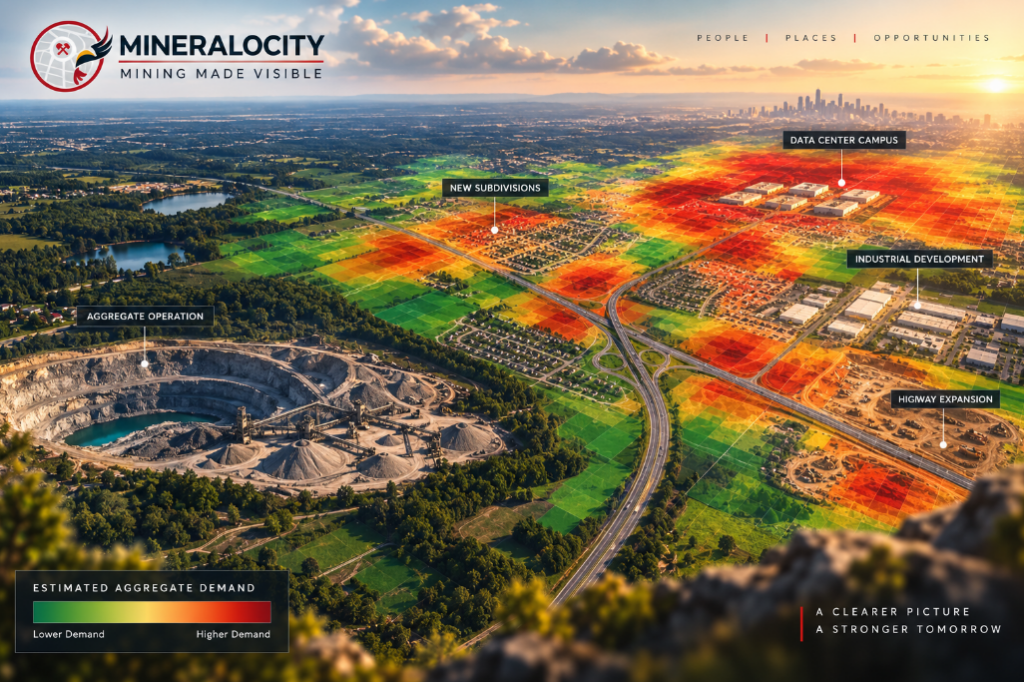
A single mile of four-lane interstate can require approximately 38,000 tons of aggregate.
And that’s one mile.
Add subdivisions, commercial construction, manufacturing facilities, data centers, road expansions, and other development, and aggregate demand can become very large, very quickly.
But the total amount of material is only part of the picture. Where that demand is developing matters just as much.
Demand isn’t spread evenly across a market. A major project or a pocket of rapid development can concentrate enormous material needs in a relatively small area.
That’s the idea behind the new Demand Level Hotspots in Mineralocity Core.
Introducing the New Demand Level Hotspots
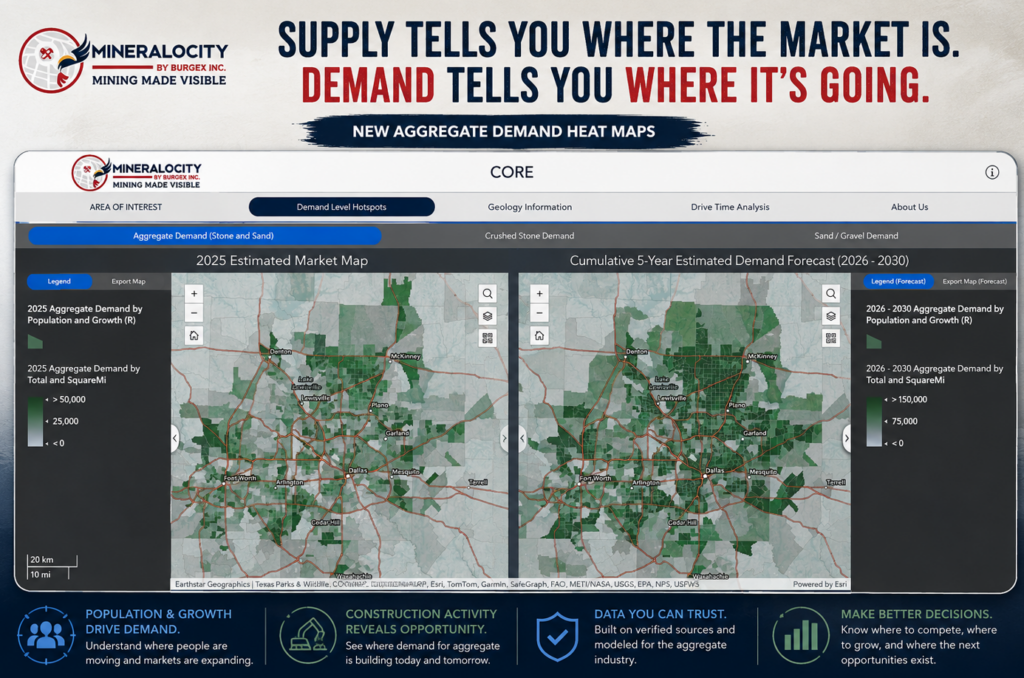
The new Demand Level Hotspots provide a more localized view of aggregate demand by bringing together population and growth patterns with construction and development activity.
Rather than looking at demand as a single number across an entire region, users can explore how conditions change geographically within a market and compare current estimated demand with cumulative five-year forecast patterns.
Users can also explore demand separately across Aggregate Demand (Stone and Sand), Crushed Stone Demand, and Sand / Gravel Demand.
The goal isn’t to predict an exact number of tons that will be needed at a particular location. It’s to provide a geographic demand signal that can be evaluated alongside the other information available within Mineralocity.
Demand Doesn’t Exist in Isolation
A high-demand area on a map doesn’t automatically mean a good opportunity. You still need to understand what’s around it.
Where are the existing aggregate operations? How much material is already being produced nearby? Who owns those operations? How far does material have to travel? What infrastructure connects supply with demand? And how much competition already exists?
Within Mineralocity, the Demand Level Hotspots can be evaluated alongside mine and quarry locations, estimated production, geology, infrastructure, transportation, ownership and other market information. Users can then use Area of Interest and Drive-Time Analysis to take a closer look at the operations and conditions surrounding a particular location.
This is especially important in aggregates because transportation can have such a large influence on the market. Demand becomes much more meaningful when you understand the production landscape surrounding it.
Supply tells you where the market is. Demand helps tell you where it may be going. Looking at both provides the context to decide where to focus next.
A New Mineralocity is Coming
We’ve also been working on something outside the platform.
A completely redesigned Mineralocity website is coming later this month, built to make it easier to understand how Mineralocity can help users evaluate markets, research producers, prioritize opportunities and understand where demand is developing.
And when a project requires a closer, site-specific look, our team at Burgex Mining Consultants can take the analysis further. PASS (Preliminary Assessment of Site Suitability) Reports provide a rapid assessment of a site or property, while a full Market Analysis provides a more comprehensive evaluation for construction aggregate sites and properties.
More on the new Mineralocity very soon. In the meantime, you can learn more about our additional analysis services below.
Learn more about Market Analysis